
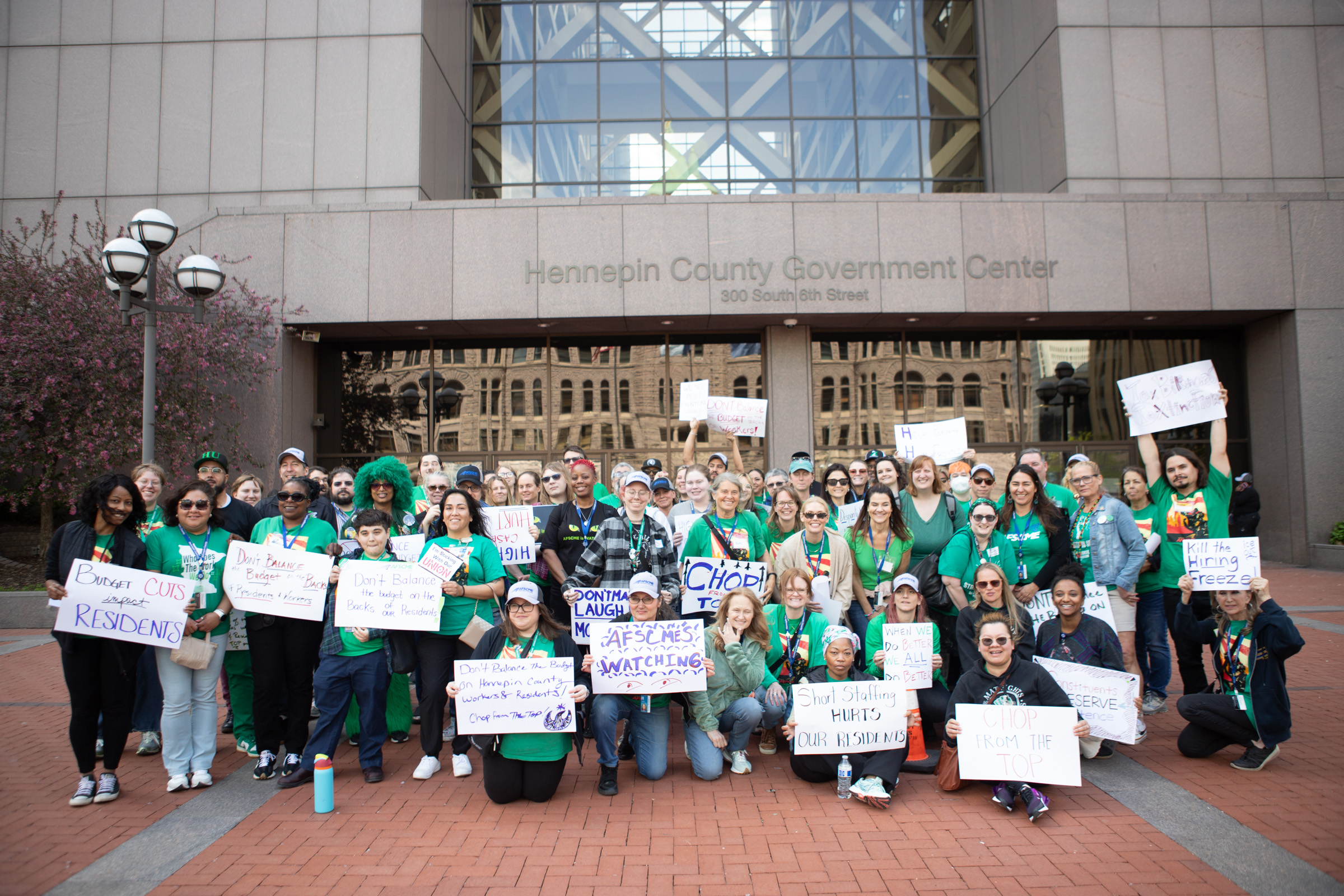
Hennepin County is facing a $30 million budget shortfall next year.
The shortfall is partly caused by the One Big Beautiful Bill Act, passed by Congress and signed by President Donald Trump last July. The bill enacts sweeping cuts to lifeline programs such as SNAP, which nourishes low-income people and families, as well as Medicaid, known in Minnesota as Medical Assistance.
As Hennepin County decides how to balance the 2027 budget, your AFSCME Local 34 and Local 2822 members, who organize library assistants, SNAP, cash, and healthcare eligibility workers, social workers, psychologists, nurses, harm reduction workers, and WIC nutritionists, reminded your Hennepin County Commissioners at their monthly committees meeting on Tuesday not to do so on our backs, as well as the backs of our residents.
John Fandrick is a Human Services Representative who works on MnSURE cases. He says they need more time to process healthcare cases. Meanwhile, people call to see if their cases have been processed, which affects workers’ ability to process cases.
“Almost every one of those calls is the same conversation. Yes, we have your paperwork. No, we haven’t processed it. No, I don’t know when we will get it completed,” Fandrick said, adding that three of his first four calls last Thursday were from anxious and stressed residents whose benefits were interrupted because they haven’t been able to complete their work. Fandrick was also assigned 10 cases on a Monday where residents have contacted Hennepin County about their cases a combined 42 times.
“Here’s the inequity: residents who follow the rules and submit their paperwork on time is most likely to have their benefits interrupted, unless they have the time to sit on hold or travel to an office. The people who call and visit aren’t the problem, they’re the symptom. They’re calling because we haven’t processed their work,” added Fandrick.
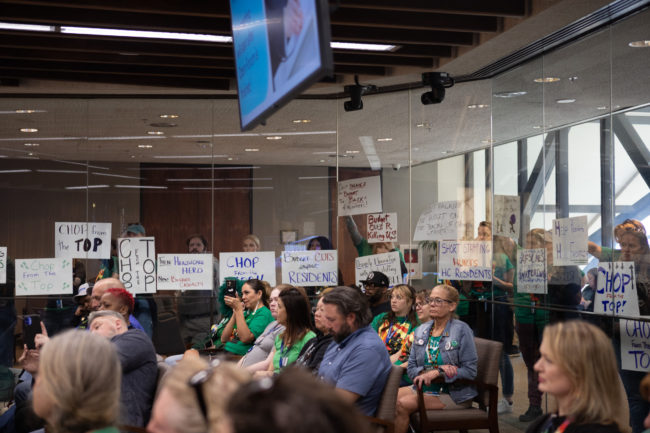
“They lose their benefits, they lose their housing, they lose their health care, they lose access to food, they lose their dignity, and in some cases, they lose their lives,” Office Support Specialist and Local 2822 member CJ Powers said. Powers greets residents visiting the Human Services Center at the Health Services Building in downtown Minneapolis to address their benefits. “Budgeting impacts communities just as severely as regular violence. It is still violence, even if it is not a gun, even if it is not a knife, even if it is not a person punching you in the face. Our residents know this. They know this intimately, and they take it out on the front line workers.”
The budget shortfall is also affecting our social workers’ ability to do their work. Callan Billings is a Local 34 steward and a social worker who conducts MnCHOICES assessments, which connects people with disabilities to resources that allow them to remain in their communities.
The increasing workload have resulted in her and her colleagues rushing through cases, spending less time meeting with people, and working nights, weekends, and holidays to keep up. Billings says they complete about 2,000 assessments per month, with each assessor completing 11 to 12 assessments.
“A single assessment often requires nine to 12 hours of work, including outreach, meeting with residents, reviewing services, documenting concerns, coordination with case managers, and meeting strict timelines,” Billings said.
“There’s compensation that is expected through our contract. Rising caseloads doesn’t mean that if we can’t get that work done in a 40 hour work week, you should be penalizing us. Our residents are suffering because we cannot keep up this pace,” Local 34 President and social worker Grace Molenaar-Maldonado said.
The Hennepin County Mental Health Center, located in south Minneapolis and serves uninsured and underinsured residents needing mental health services, is also short-staffed. Kate Oddi, who is a psychologist at the Hennepin County Mental Health Center in south Minneapolis, says the short staffing, exacerbated by the recent departure of a psychologist who will not be replaced, affects their ability to complete detailed neurodevelopmental and mental health evaluations.
“Providers have far less time to spend with patients, communicate results to care teams, and help individuals and families connect with appropriate supports and services,” Oddi said, adding those affected include young children who are autistic and need evaluations to access early intervention services, parents involved with the child protection system seeking reunification with their children, and adolescents involved with the juvenile justice system whose mental health needs are overlooked.
The Hennepin County Board expects to receive an update on the 2027 budget in June.
